
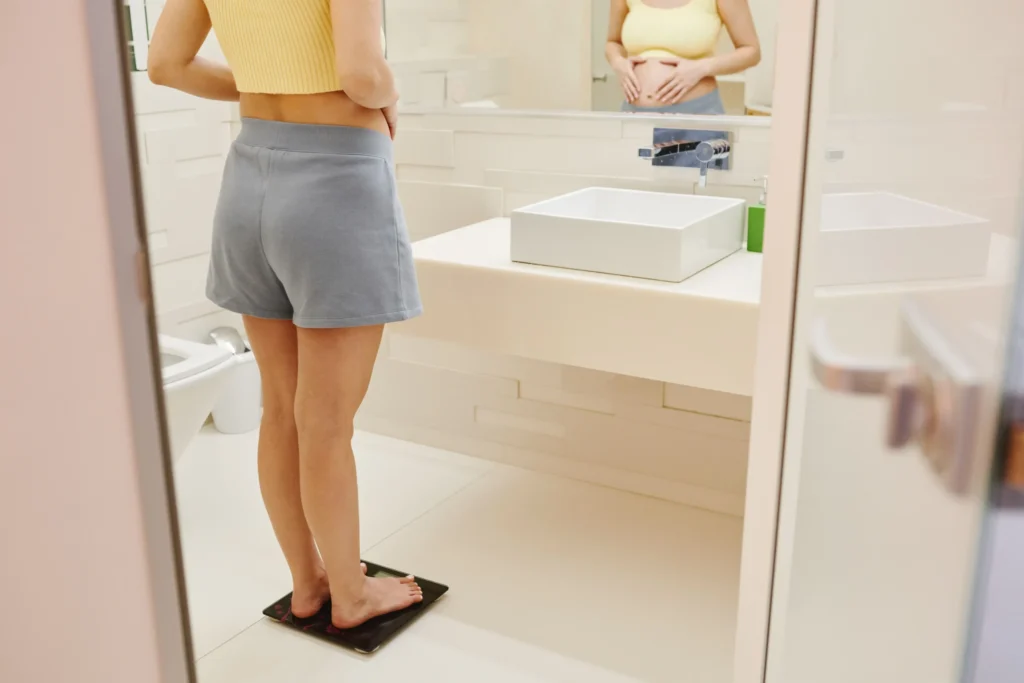
You step on a smart scales and it shows more than your weight: body fat, muscle mass, water percentage, even a “body age.” It looks precise, but how does a bathroom scale know what’s inside your body, and how far should you trust the numbers?
This guide explains what smart scales measure, what they only estimate, and how to get readings that are useful for tracking your progress.
How Does a Smart Scale Measure More Than Weight?
Weight is the one thing a scale measures directly, through the load sensors under the platform. Everything else is an estimate.
Most smart scales and body analyzers use bioelectrical impedance analysis (BIA). The scale sends a very weak electrical current through your body, usually through metal electrodes under your feet. Different tissues let that current pass with different ease, and water conducts it well. The scale measures the resistance, then runs it through a formula that also uses your age, sex, and height to estimate your body composition.
So a “body fat” number is a calculated guess based on resistance, not a direct measurement. That is why two scales can give you different numbers on the same morning.
What Smart Scales Actually Report
Measured directly
- Weight: Reliable on most quality scales.
Estimated through BIA
- Body fat percentage: An approximation of how much of your weight is fat.
- Muscle mass or skeletal muscle: Inferred from resistance and the scale’s formula.
- Body water percentage: Closely tied to what BIA detects, but easily shifted by your hydration that day.
- Bone mass: Calculated by the scale’s algorithm, not scanned.
Calculated from other numbers
- BMI: Weight divided by height squared. It is a simple formula, not a body scan.
- “Metabolic age” or “body age”: A marketing-style score based on the scale’s own formulas. Treat it as a curiosity, not a medical result.
How Accurate Are They?
Home scales are useful for trends, not for precise answers. Houston Methodist notes that hydration status is the biggest limitation of body composition scales. The same source points out that scales with more contact points tend to be more accurate, and that basic two-point models are affordable but less precise. The best use of an at-home scale is tracking larger changes over time with the same device under the same conditions.
Medical methods such as DEXA scans are more accurate than any home scale, so don’t treat your scale’s body fat number as a clinical result.
What Can Throw Off Your Readings
- Hydration: Dehydration can make body fat look higher, and drinking a lot of water can change the reading too.
- Time of day: Your body’s water balance shifts through the day.
- Recent meals, exercise, and sweating: All of them change fluid levels.
- Dry or very thick foot skin: Poor contact can affect the signal.
- Moving the scale: Using different floors, such as carpet versus tile, can change the weight reading.
- Different devices: Each brand uses its own formulas, so numbers from two scales aren’t comparable.
How to Get More Consistent Results
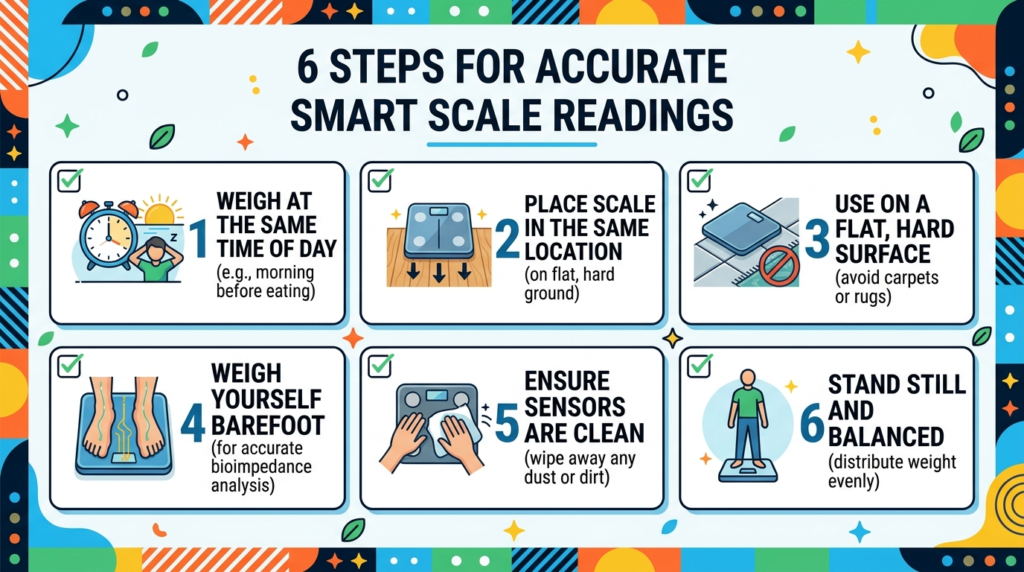
- Put the scale on a hard, flat floor and leave it there.
- Weigh yourself at the same time each day. Many people choose the morning, after using the bathroom and before eating or drinking.
- Step on barefoot with clean, dry feet. Stand still with your weight centered.
- Set up your profile correctly. Enter the right age, height, and sex, and update them when needed.
- Look at weekly averages, not single readings. A sudden overnight jump in body fat is more likely water than real fat gain.
- Stick to one scale so your trend line stays meaningful.
Who Should Be Careful or Skip the Body Analysis
Because BIA sends a small electrical current through the body, some people should avoid it. Withings, for example, does not recommend its impedance features for people with pacemakers and offers a “Weight-Only Mode” that turns them off. Researchers have also reported that bioimpedance sensors in some consumer devices could interfere with implanted cardiac devices in certain conditions.
Check your scale’s manual and ask your doctor before using body composition features if you:
- Have a pacemaker, implanted defibrillator, or other electronic medical implant
- Have a metal implant, especially in the legs
- Are pregnant (many manufacturers advise against using the body analysis feature)
You can still use the scale for weight alone.
Common Mistakes to Avoid
- Treating body fat as a diagnosis. It is an estimate, not a medical test.
- Panicking over daily changes. Water and food cause normal swings.
- Comparing your numbers to other people’s scales. Formulas differ.
- Chasing a “perfect” number. Healthy ranges vary with age, sex, and body type.
- Ignoring how you feel. Energy, strength, sleep, and how your clothes fit matter too.
- Relying on BMI alone. The CDC explains that BMI is not a direct measure of body fat, so someone with a lot of muscle can have a high BMI without excess body fat.
Is a Smart Scale Worth It?
It can be, if you want an easy way to log weight and watch trends. The app connection saves you from writing numbers down, and some scales sync with health apps and smart home routines. Choose a smart scale if you will use it consistently, if you accept its numbers as estimates, and if you don’t have an implanted medical device.
A basic scale is enough if you only care about weight, or if the detailed numbers would make you anxious rather than informed.
Frequently Asked Questions
Are smart scale body fat readings accurate?
They are estimates. They can be good for seeing your own trend over weeks, but they are less accurate than clinical methods and can vary by scale and hydration.
Why does my body fat change so much from day to day?
Mostly because of hydration, meals, exercise, and time of day. Compare averages over a few weeks rather than single readings.
Can I use a smart scale if I have a pacemaker?
Ask your doctor first. Many manufacturers advise against the body analysis feature with implanted devices, though weight-only use is typically fine. Check your model’s manual.
Is BMI on a smart scale reliable?
It is a simple height-and-weight calculation. It can be a quick screening tool, but it doesn’t separate muscle from fat, so it can misjudge athletic or muscular people.
What is the best time to weigh myself?
Choose a consistent time. Many people prefer the morning after using the bathroom, before eating or drinking.
Conclusion
A smart scale measures weight accurately, but its body fat, muscle, and water numbers are estimates based on a weak electrical current and a formula. Use one scale, weigh at the same time and under the same conditions, focus on long-term trends, and leave the body analysis off if you have a pacemaker or similar implant. Used this way, a smart scale is a simple tracking tool that fits easily into a connected home. It doesn’t replace advice from a healthcare professional.